The Complete International Morse Code Alphabet Chart
The International Morse code alphabet uses dots and dashes to represent every letter from A to Z, numbers 0 to 9, and common punctuation marks. Each character has a unique pattern that cannot be confused with any other. Click any letter below to hear how it sounds, or use the download button to save the printable chart.
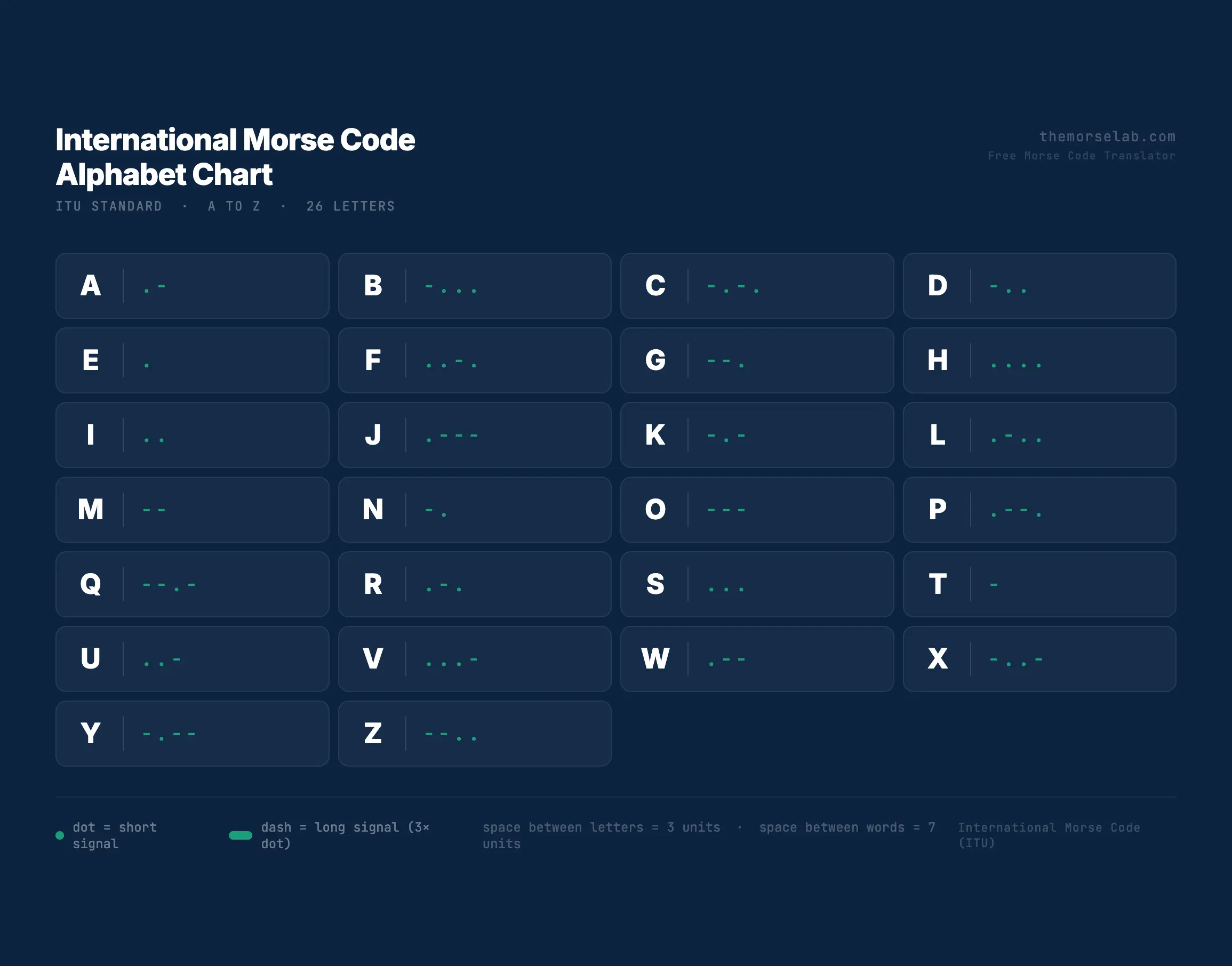
Tap any card to hear its Morse code · tap again to stop
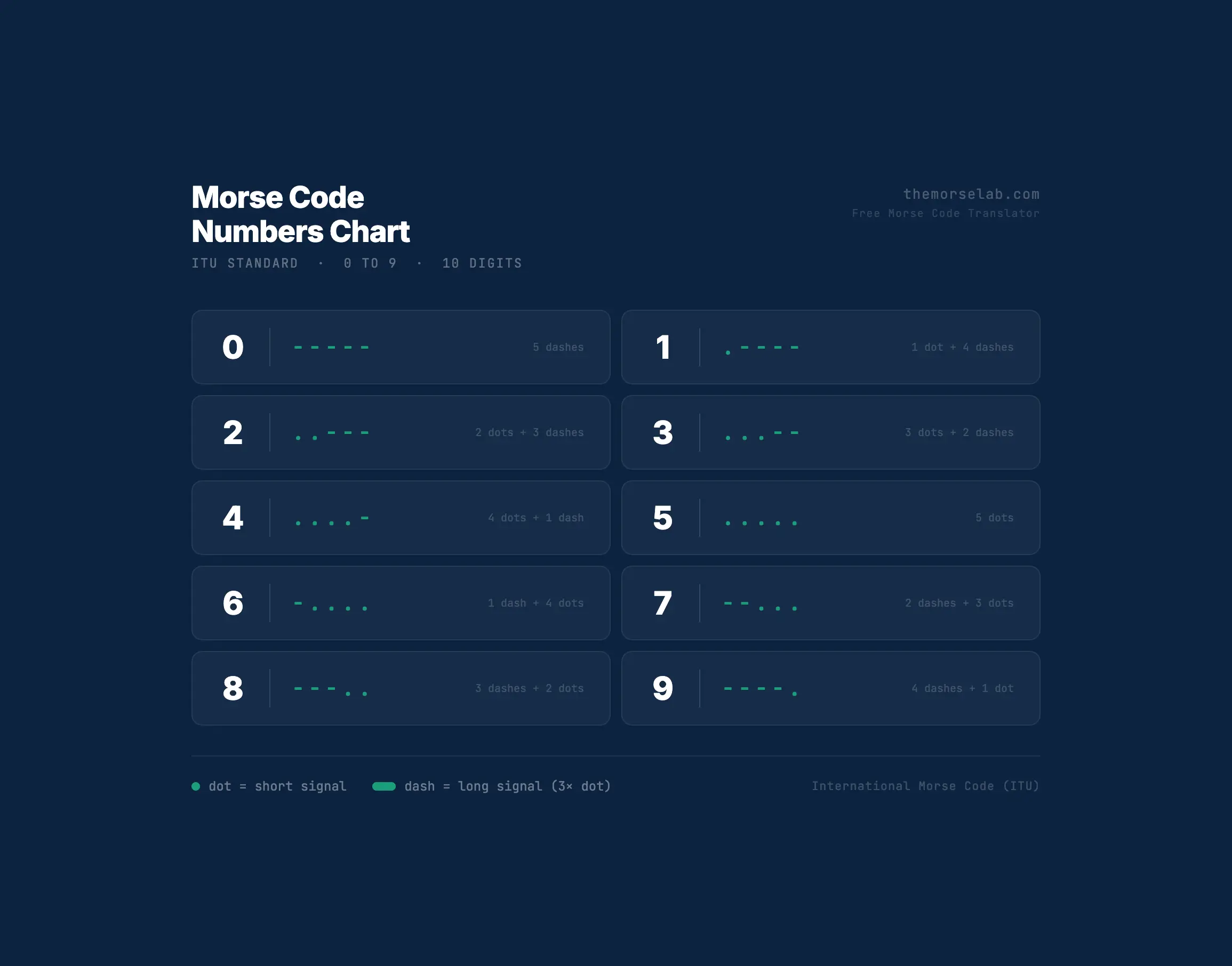
Numbers 1-5: dots first, then dashes · Numbers 6-9: dashes first, then dots · 0: five dashes
Morse Code Punctuation and Symbols
The most commonly used punctuation marks in International Morse Code for quick reference.
| Symbol | Name | Morse Code | Symbol | Name | Morse Code |
|---|---|---|---|---|---|
| . | Period / Full stop | .-.-.- | ? | Question mark | ..–.. |
| , | Comma | –..– | ! | Exclamation mark | -.-.– |
| : | Colon | —… | / | Slash | -..-. |
| – | Hyphen / Dash | -….- | @ | At sign | .–.-. |
| ‘ | Apostrophe | .—-. | ( | Open bracket | -.–. |
| “ | Quotation marks | .-..-. | ) | Close bracket | -.–.- |
| + | Plus sign | .-.-. | = | Equals sign | -…- |
How to Read the Morse Code Alphabet Chart
Reading the chart is straightforward once you understand the two building blocks: the dot and the dash.
A dot is a short signal, one unit of time. A dash is a long signal, three units. The gap between two signals within the same letter is one unit. The gap between two different letters is three units. The gap between two words is seven units.
So when you see A written as .- it means: one short signal, pause, one long signal. When you hear it played, that is exactly what you get: dit dah. Once you start thinking in sounds rather than symbols, the alphabet becomes much easier to learn and remember.
How to Learn the Morse Code Alphabet
Most people approach this the wrong way. They try to memorise every letter at once, going A to Z in alphabetical order. That approach rarely sticks. The better method is to learn by pattern, by sound, and by frequency.
Start With the Two Easiest Letters
E is a single dot (.). T is a single dash (–). These are the most common letters in English and the shortest codes in the entire alphabet. Learn these two first (it takes about five minutes) and you already have a foundation. I is two dots (..) and M is two dashes (—). These four letters alone cover an enormous proportion of everyday English text.
Learn by Sound, Not by Symbol
The fastest learners do not say “dot dash” in their head. They say dit dah. Morse code is a rhythm, not a reading exercise. When you click any card in the chart above, listen to the rhythm and say it out loud. A sounds like dit-DAH. K sounds like DAH-dit-DAH. Your ear will start recognising patterns before your brain consciously processes them.
Use the Mirror Pairs
Several letters are mirror images of each other, reversed versions of one another. Once you know one, the other just flips. Learning pairs cuts your memorisation load almost in half.
Build Up Through Short Words
Once you know E, T, I, M, S, and O you can already read SOS (… — …) and short words like IT, IS, ME, SO, and TIE. Learning through real words builds genuine pattern recognition rather than isolated symbol memory. Our practice tool is built around exactly this approach, starting with the most frequent letters and adding new ones gradually.
Morse Code Alphabet vs NATO Phonetic Alphabet
These two systems are often mentioned together, but they serve completely different purposes and it is worth understanding the difference clearly.
The NATO phonetic alphabet (Alpha, Bravo, Charlie, Delta) is a spoken system. It replaces individual letters with distinct words so that voices can be understood clearly over poor radio connections or in noisy environments. You say “Sierra” instead of “S” because the word Sierra cannot be mistaken for “F” or “X” even through heavy static.
Morse code is not spoken. It is transmitted as timed sound pulses, light flashes, radio waves, or physical taps. Each letter has a dot-dash pattern, not a word equivalent. The two systems are used in some of the same contexts. HAM radio operators and military communicators use both, but they are parallel tools with different strengths, not alternatives to each other.
International Morse Code vs American Morse Code
When people search for the Morse code alphabet they almost always mean International Morse Code, the ITU standard used worldwide today. But there is an older version worth knowing about.
American Morse Code was the original system created by Samuel Morse and Alfred Vail in the 1840s. It used more complex spacing rules, internal gaps within single characters, and an extra-long dash for certain letters. It was the standard across US telegraph networks for decades, which is why it is also called Railroad Morse.
International Morse Code replaced it globally in 1865 when the International Telecommunication Union standardised the cleaner system developed by Friedrich Gerke. Today, International Morse is the worldwide standard. American Morse is largely historical, though some HAM radio operators and telegraph preservation societies still practise it.
The chart on this page shows International Morse Code. If you need American Morse, our dedicated translator page covers it in full.