Morse Code Translator
· · · themorselab.com · · ·
How to Use the Morse Code Translator
The translator is simple to use in both directions. Whether you are converting a message to Morse or decoding a Morse signal you received, the process takes seconds.
How to Translate Text to Morse Code
Type or paste your message into the Text box on the left. The Morse code translation appears in the Morse Code box instantly as you type, no button press needed.
- Type or paste your message into the Text box. For example, type SOS.
- The Morse code appears automatically in the Morse Code box:
... --- ... - Click Play to hear your message as Morse code beeps.
- Click Copy Morse to copy the code to your clipboard.
- Click Save Audio to download the Morse code as a WAV audio file.
- Click Send Friend to share it as a puzzle via WhatsApp, Telegram, or Email.
How to Decode Morse Code to Text
Paste your Morse code into the Morse Code box on the right. Use a dot . for each dot, a hyphen - for each dash, a space between letters, and a forward slash / between words.
- Paste your Morse code into the Morse Code box on the right.
- The decoded text appears automatically in the Text box.
- Click Play to hear the message as audio.
- Click Copy Text to copy the decoded result.
Sound, Light, Vibration and Playback Controls
Below the translation boxes you will find a full playback bar with everything you need to hear, see, and feel your Morse code message.
What is Morse Code?
Morse code is a method of communication developed between 1837 and 1844 by Samuel Morse and Alfred Vail for use on the electric telegraph. Instead of letters and words, it uses patterns of short signals (dots) and long signals (dashes) to represent each character of the alphabet, each numeral, and punctuation marks.
A dot is a brief signal, a short beep, a quick tap, or a flash of light. A dash is three times the length of a dot. Different combinations of dots and dashes represent different letters. S is three dots . . . and O is three dashes - - -, which is why SOS (the most famous Morse signal) is . . . - - - . . .
Morse code can be transmitted as sound through a speaker or radio, as light through a torch or signal lamp, as electrical pulses through a wire, or as physical taps on any surface. In 1865, the International Telegraph Union adopted the International version as the global standard. It has been used worldwide ever since, in aviation, maritime communication, amateur radio, and emergency signalling.
International Morse Code vs American Morse Code
There are two versions of Morse code, and understanding the difference matters if you want to communicate with others or use historical equipment.
Developed by Clemens Gerke in 1848. Adopted by the ITU in 1865 as the worldwide standard. Uses only two signal lengths, dot and dash (3× dot). Fixed, consistent spacing rules. Used today in amateur radio, aviation, maritime communication, and all modern training. Our translator defaults to this version.
Created by Samuel Morse and Alfred Vail in the 1840s. Used across US telegraph networks as Railroad Morse. More complex spacing rules with internal gaps within some letters and an extra-long dash for certain characters. Largely historical today, though HAM enthusiasts still practise it.
International Morse Code
International Morse code is also known as Continental Morse code. It was developed by Clemens Gerke in 1848 as a cleaner, more consistent version of the original American system. In 1865, the International Telegraph Union (ITU) adopted it as the worldwide standard, and today it is the version used everywhere, in amateur radio, aviation navigation beacons, maritime communication, and all modern Morse code training.
The spacing rules are precise: one unit of silence between each dot or dash within a letter, three units between letters, and seven units between words. This consistency makes it much easier to learn and less prone to errors during transmission.
American Morse Code
American Morse code, also called Railroad Morse, is the original system created by Samuel Morse and Alfred Vail in the 1840s. It was used across the United States telegraph network for decades. The American version uses more complex spacing rules and includes some characters with internal gaps, pauses within a single letter, which made it harder to standardise internationally. It also uses an extra-long dash for certain characters.
This translator covers International Morse Code. For American Morse Code translation, use our American Morse Code Translator.
Morse Code Alphabet and Number Chart
The chart below shows the International Morse code for every letter and number. Use it as a quick reference while encoding or decoding. A dot . is a short signal and a dash - is a long signal, three times the length of a dot.
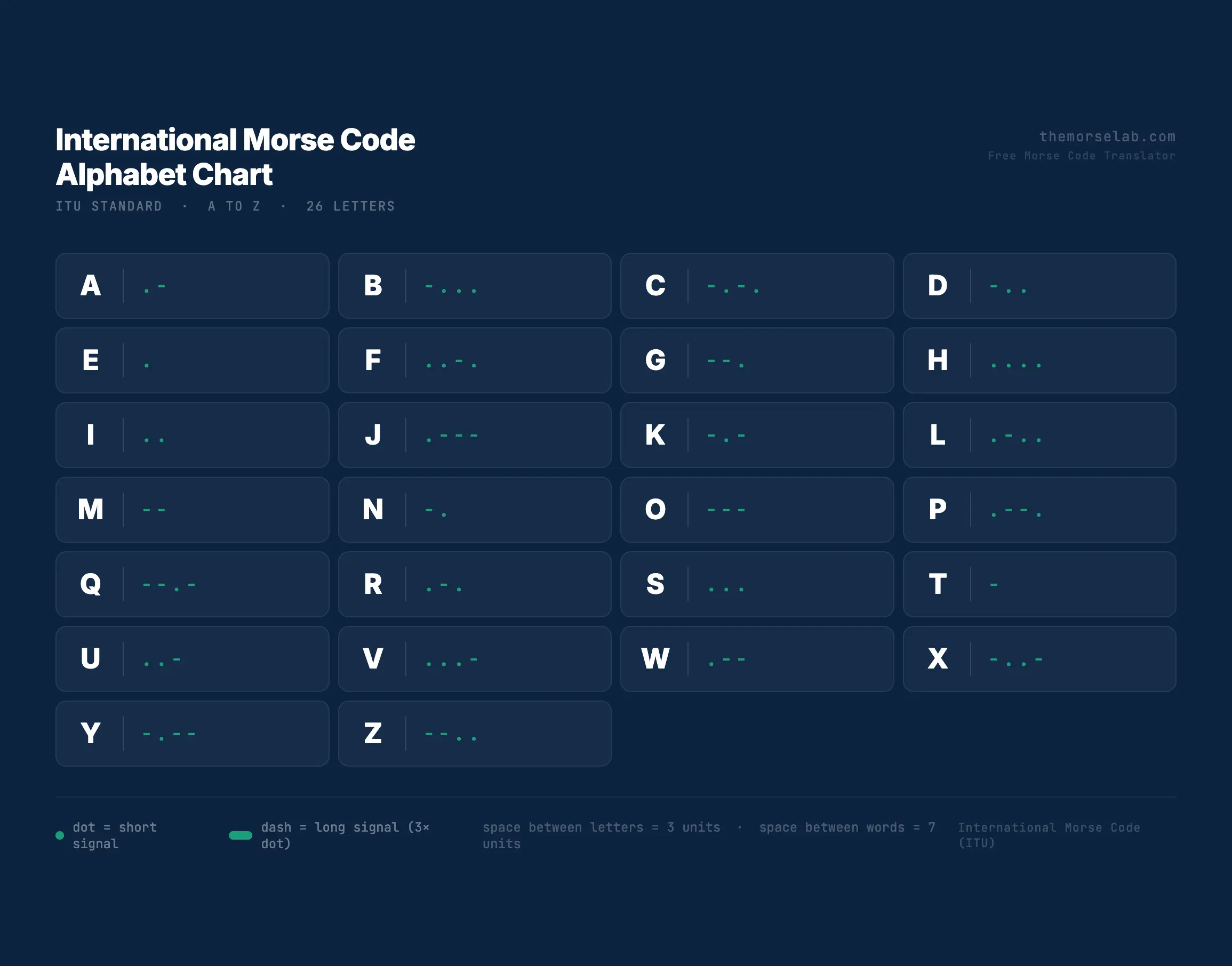
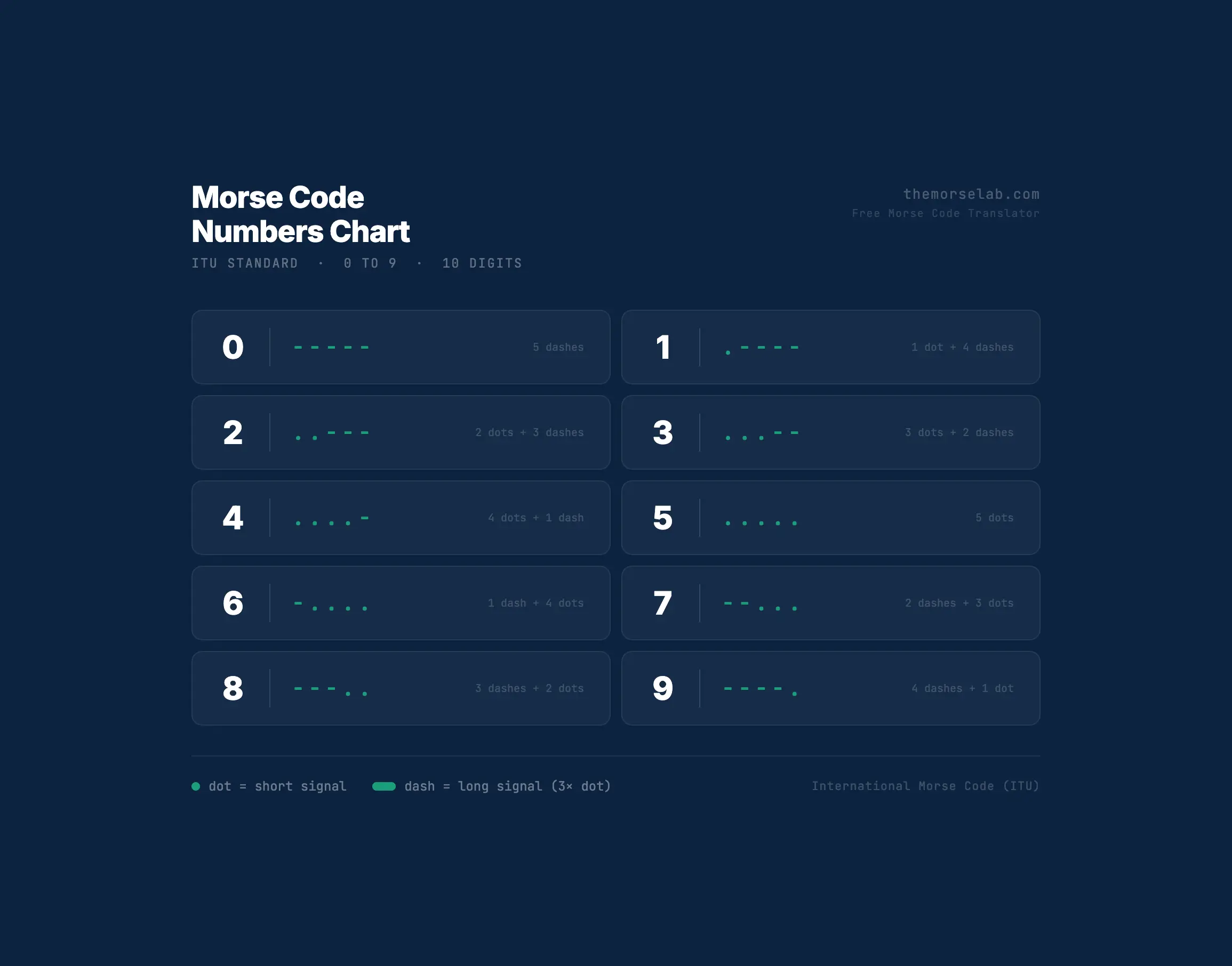
Common punctuation: period .-.-.- comma --..-- question mark ..--.. exclamation -.-.-- slash -..-.
How to Read and Write Morse Code
Morse code is a rhythm-based language. Once you understand the timing, short, long, pause, reading and writing it feels like tapping along to a beat. The key is learning the pattern for each letter, not memorising abstract sequences.
Reading Morse Code, The Decoding Process
Decoding Morse means converting the dots, dashes, and spaces back into letters and words. Each letter has its own unique pattern. Listen for the rhythm, match it to the chart, and read the gaps between groups as letter and word separators.
Spacing rules: a tiny gap separates dots and dashes within the same letter, a medium pause separates different letters, and a longer pause separates whole words.
. . . = S – – – = O . . . = S
. . . . = H . = E . – . . = L . – . . = L – – – = O
Writing Morse Code, The Encoding Process
Encoding means converting letters into their Morse patterns. Take each letter in your message, look up its dot-dash pattern in the chart above, and write them out with a space between each letter and a slash / between words.
M — O — R .-. S … E .
Result: — — .-. … .
Proper spacing is the key to correct Morse code. Without clear gaps between letters and words, the receiver cannot tell where one character ends and the next begins. Use our translator above to check your work as you practise.
What is SOS in Morse Code?
Many people assume SOS stands for “Save Our Souls” or “Save Our Ship”, but it does not stand for anything at all. The letters were chosen purely because of how they look in Morse code: three dots, three dashes, three dots. This pattern is completely symmetrical, impossible to confuse with any other signal, and very fast to transmit, even by someone with no Morse training who only knows the distress pattern.
SOS became the official international maritime distress signal in 1906 at the Berlin Radiotelegraphic Conference. Before SOS, ships used different signals, the most common was CQD, which was the British Marconi company’s distress call. The Titanic famously transmitted both CQD and SOS during its sinking in 1912, making it one of the earliest real-world uses of the SOS signal in an emergency.
To transmit SOS manually: three short taps, three long taps, three short taps. On any surface, with any object, in any medium, sound, light, or taps through a wall. No equipment needed. That simplicity is exactly why it became the universal standard.
Where is Morse Code Used Today?
Morse code is over 180 years old but it has not disappeared. It is still actively used in several fields, and its influence reaches into modern technology, entertainment, and accessibility in ways most people do not realise.
CW (continuous wave) is the Morse mode of radio transmission. Morse signals travel further with less power than voice. HAM operators worldwide use it daily, and global Morse contests attract thousands of participants each year.
Non-Directional Beacons (NDBs) transmit their station identifier as a repeating Morse code signal. Pilots identify these beacons by their Morse patterns during instrument approaches. If you listen to an NDB audio feed, you hear Morse code.
SOS remains the internationally recognised distress signal. Three short, three long, three short, tapped, flashed, or shouted on any surface or medium. Survival courses worldwide teach this pattern as a core emergency communication skill.
People with severe physical disabilities, including locked-in syndrome and ALS, communicate via Morse code using eye-blinks, finger movements, or breath-activated switches. Google and Apple have both integrated Morse input into their accessibility features.
Morse code puzzles appear in escape rooms, video games, and competitive puzzle events worldwide. Films including Interstellar and The Imitation Game feature Morse code prominently. Our Decode Game is designed for exactly this audience.
Morse code remains part of many scouting programmes, military training curricula, and radio operator licences worldwide. It is one of the few communication skills that requires no technology to use in an emergency.
Common Morse Code Words and Phrases
Some Morse code phrases get used so often that learners and operators recognise them on sight. The patterns below cover everyday words, distress signals, names, and the kind of short phrases people typically want to translate first. Tap any phrase into the translator above to hear how it sounds, see the timing, or download the audio.
For deeper word lists, name spellings, and translations of phrases like good morning, happy birthday, or proper nouns, browse our Morse Code Words and Phrases page.
Morse Code Speed (WPM) and Farnsworth Timing Explained
Morse code speed is measured in words per minute (WPM). The standard reference word is PARIS, which contains exactly fifty units of dot, dash, and gap timing. So twenty WPM means transmitting the word PARIS twenty times in a minute. Beginners typically start at five to ten WPM, casual operators work at fifteen to twenty WPM, and skilled HAM radio operators comfortably reach thirty to forty WPM.
The Five Timing Units
All Morse timing comes from one base unit, the length of a single dot. Everything else is a multiple of that unit:
- Dot: 1 unit long
- Dash: 3 units long
- Gap between parts of the same letter: 1 unit
- Gap between letters: 3 units
- Gap between words: 7 units
Get those right and Morse code becomes readable. Get them wrong and even simple letters blur together.
What is Farnsworth Timing?
Farnsworth timing is a learning technique. Instead of slowing the whole signal down at low WPM, which trains your ear to listen for individual elements rather than full letter shapes, Farnsworth keeps each character at a faster speed (eighteen to twenty WPM) but stretches the gaps between letters and words. The result: you learn to recognise letters by their natural rhythm from the start, and as you improve, you simply close the gaps. Most modern Morse code learning tools, including the Configure panel in the translator above, support Farnsworth timing for this reason.
To try it, open Configure in the translator, set the Character Speed slider to twenty WPM, and drop the Overall Speed to ten WPM. You will hear each letter at a real-world pace, with extra space to think between them.
Q-Codes and Prosigns: Morse Code Shorthand
Skilled Morse operators rarely send full sentences. Instead, they use a shorthand system of three-letter Q-codes and special procedural signals (prosigns) that compress common questions and statuses into a few characters. If you have ever heard amateur radio operators chatting in Morse, what sounds like nonsense is usually a steady flow of these abbreviations.
Common Q-Codes
Each Q-code can be a question or a statement. A question mark in Morse (..--..) after the code makes it a question.
| Q-Code | Meaning |
|---|---|
| CQ | Calling any station, anyone listening |
| QTH | What is your location? / My location is… |
| QSL | Do you confirm? / I confirm receipt |
| QRZ | Who is calling me? |
| QRM | I am being interfered with |
| QRN | I am troubled by static |
| QSY | Change frequency |
| QRT | Stop sending / I am closing down |
Common Prosigns
Prosigns are letter combinations sent without the usual gap between them, treated as a single procedural signal. They mark the start, end, and structure of a message.
| Prosign | Morse | Meaning |
|---|---|---|
| AR | . – . – . | End of message |
| SK | . . . – . – | End of contact (final sign-off) |
| BT | – . . . – | Break / pause / new paragraph |
| KN | – . – – . | Go ahead, specific station only |
| K | – . – | Go ahead, anyone |
| AS | . – . . . | Wait / standby |
Friendly Sign-Offs
Two numeric expressions you will hear constantly in amateur radio: 73 means “best regards” and 88 means “love and kisses” (traditionally sent to a partner or close family member). Both are sent as numbers, not letters, and they finish a contact on a warm note.
Test Your Skills: The Morse Code Decode Game
The Morse Lab includes a built-in Morse code decode game designed for escape room enthusiasts, learners, and anyone who wants to test their decoding speed.
Correct answers score +10 points. A streak of three or more in a row earns a +5 bonus. Use the Hint button to reveal every third letter at a cost of 5 points. Click Hear It to play the Morse code as audio, ideal for training your ear as well as your eye. Your stats, correct answers, wrong answers, best streak, and average time, are tracked across your session.
Why Use The Morse Lab Translator?
The Morse Lab is completely free with no account required. It translates instantly as you type. Here is what makes it stand out:
Frequently Asked Questions
--... ...--), not letters. The expression dates back to the 1850s telegraph code books, where 73 was already in use as a polite closing among operators. A related expression, 88, means “love and kisses” and is reserved for close family or romantic partners.