SOS Morse Code
SOS in Morse code is · · · — — — · · ·, which is three dots, three dashes, three dots. It is the internationally recognised distress signal, chosen in 1906 and still used today. This page covers the full pattern, how to signal SOS using light, tapping, sound, and eye blinks, plus the history behind how it came to be. If you want to convert any word or phrase into Morse code, our free Morse code translator handles that on the homepage.
What Is SOS in Morse Code?
SOS in Morse code is the sequence · · · — — — · · ·, which is three dots, three dashes, three dots. It is sent as a single, continuous signal with no pauses between the three letters. That is what makes it a prosign rather than three separate characters. If you simply sent S, then O, then S individually with the normal gap between each letter, that would technically be a different signal. The real SOS runs the whole thing together without stopping.
What Does SOS Stand For?
Here is the part most websites get wrong: SOS does not officially stand for anything. It never did. Phrases like “Save Our Souls” and “Save Our Ship” are popular backronyms: catchy phrases invented after the signal already existed, not the original meaning. When SOS was agreed upon at the International Radiotelegraph Convention in 1906, the delegates were not thinking about what the letters spelled. They were thinking about the pattern. Three short, three long, three short. Simple. Symmetrical. Unmistakeable.
Why Was SOS Chosen?
The pattern was chosen because it is almost impossible to confuse with anything else. Three dots, three dashes, three dots is symmetrical. Read it forwards or backwards and it is the same sequence. That matters enormously when a signal might only be partially received through static or interference. Even if you only catch the last half of the transmission, you still know what it is. It is also extremely fast to send, which is exactly what you need in an emergency.
How to Signal SOS in Morse Code
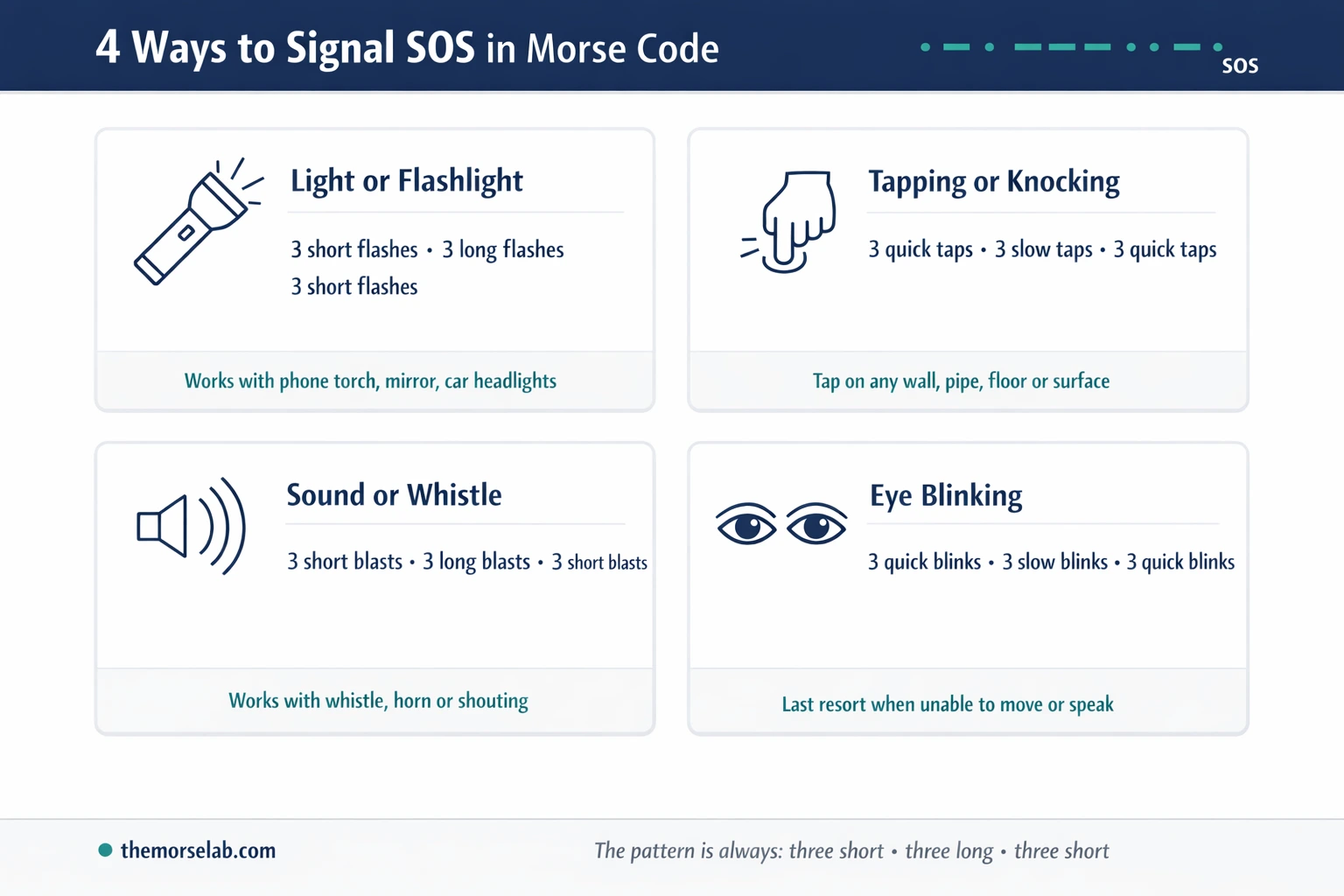
SOS can be sent using any repeatable signal: light, sound, tapping, or even eye blinks. The pattern is always the same: three short, three long, three short. Pause briefly, then repeat until help arrives.
Using a Flashlight or Light Signal
Pause for 1 to 2 seconds between each group, then repeat the whole sequence. Works with a phone torch, a flashlight, car headlights, or a mirror reflecting sunlight in daylight. Light signals travel much further than sound in open water or wilderness, which is why this method is used internationally as a maritime and wilderness rescue signal.
Tapping or Knocking SOS
Tap on any hard surface: a wall, pipe, floor, table, or window. Pipes and structural walls carry sound a long way, which is why emergency services specifically listen for rhythmic tapping when searching collapsed buildings. If you are ever trapped, keep the rhythm steady and consistent. Three quick, three slow, three quick, pause, repeat.
Using Sound or a Whistle
Three short blasts, three long blasts, three short blasts. Pause and repeat. A whistle carries further than shouting and uses far less energy, which makes it the recommended tool for hikers and outdoor enthusiasts in distress. You can also use a car horn, a foghorn, or even banging two hard objects together rhythmically. To hear exactly what SOS sounds like in Morse code, use our Morse code audio decoder and play the tool at the top of this page.
Blinking SOS with Your Eyes
Three quick blinks for S, three slow deliberate blinks for O, three quick blinks for S again. This method is a genuine last resort used when someone cannot speak, move, or make a sound. For example, a survivor in a collapsed structure who has lost mobility, or a person in a medical emergency who is fully conscious but physically unable to communicate in any other way. It has also been used as an assistive communication method for people with severe motor impairments. If someone appears to be trying to communicate with their eyes, watch carefully for the three-three-three pattern.
The History of SOS in Morse Code
The story of SOS starts not with a rescue at sea but with a problem of standardisation. In the early 1900s, ships were beginning to carry wireless radio equipment, but different companies and countries were using different distress signals. A ship in trouble in foreign waters might be broadcasting on a frequency no one was monitoring, using a signal no one recognised. That was dangerous.
In 1905, the German government was the first to formally adopt · · · — — — · · · as a distress signal in its national radio regulations. The following year, at the International Radiotelegraphic Convention held in Berlin in 1906, the signal was written into international law. Article XVI of the convention stated that ships in distress shall use the following signal: three dots, three dashes, three dots, repeated at brief intervals. It became effective worldwide on 1 July 1908.
SOS remained the official maritime radio distress signal for nearly a century, until 1999 when it was replaced by the Global Maritime Distress and Safety System, a satellite-based system that automates much of what radio operators once did manually. But SOS remains a recognised distress signal to this day and can still be used legally with any signalling method.
What Was CQD and Why Was It Replaced?
Before SOS, the standard distress signal used by ships carrying Marconi Company wireless equipment was CQD. The Marconi Company issued a circular in January 1904 specifying that all its operators should use CQD when a ship was in distress or required urgent assistance. CQ was already a standard telegraph call meaning “attention all stations”, and D was simply added to indicate distress.
The problem with CQD was that under poor signal conditions it could easily be mistaken for a routine CQ general call. Someone partially receiving CQD might hear only CQ and assume it was a normal broadcast. SOS had no such ambiguity. The pattern (three short, three long, three short) is so distinctive and so rhythmically different from any other signal that it cannot be misread, even through heavy static.
When the RMS Titanic struck an iceberg, senior radio operator Jack Phillips initially sent CQD, the older Marconi signal he was most familiar with. Junior operator Harold Bride reportedly suggested switching to SOS, half-jokingly saying it might be their last chance to use the new code. Phillips then began alternating between both signals. Bride survived. Phillips did not. The Titanic disaster, more than any other event, cemented SOS as the signal everyone knew.
SOS Morse Code Pattern: Written Out
Here is the complete SOS pattern for reference. You can copy the text form and use it however you need, or explore our Morse code alphabet chart to see how every letter is coded.
| Letter | Morse Code | Written Out | Description |
|---|---|---|---|
| S | · · · | … | Three dots |
| O | — — — | — | Three dashes |
| S | · · · | … | Three dots |
The overscore notation means the signal is transmitted as one unbroken sequence. There are no inter-letter gaps between S, O, and S. Only the inter-element gaps between each individual dot and dash within the pattern.
SOS and Mayday: What Is the Difference?
SOS is a Morse code distress signal. Mayday is its spoken equivalent, adopted in 1927 from the French phrase m’aider, meaning “help me.” Both signal the same level of emergency: imminent threat to life or vessel. Mayday is used in voice radio communications where transmitting Morse code is not practical. If you hear either one, treat it as a genuine emergency.
Frequently Asked Questions
SOS in Morse code is · · · — — — · · ·, which is three dots, three dashes, three dots. It is the internationally recognised distress signal, sent as a single continuous sequence with no pauses between letters. In text form it is written as … — …
No. SOS does not officially stand for anything. Phrases like “Save Our Souls” and “Save Our Ship” are popular backronyms but were never the original meaning. SOS was chosen in 1906 purely because the Morse pattern of three dots, three dashes, three dots, is simple, symmetrical, and unmistakeable. The letters themselves were chosen to represent a memorable shorthand for that pattern, not the other way around.
Flash 3 short pulses for S, 3 long pulses for O, then 3 short pulses for S again. Pause briefly, then repeat the sequence. Works with any light source: a phone torch, flashlight, car headlights, or a mirror reflecting sunlight in daylight. Keep the short pulses brief and the long pulses noticeably longer so the difference is clear to anyone watching.
SOS was chosen at the 1906 International Radiotelegraphic Convention because the Morse code pattern of three dots, three dashes, three dots, which is symmetrical, fast to send, and nearly impossible to confuse with anything else. It replaced the earlier signal CQD, which was harder to distinguish from a routine general call under poor reception. SOS has no ambiguity at all. The pattern is the same forwards and backwards.
Yes. Tap 3 quick taps for S, 3 slow deliberate taps for O, then 3 quick taps for S again. Repeat the pattern on any surface: a wall, pipe, floor, or table. Keep the rhythm consistent and the difference between the quick taps and the slow taps as clear as possible. Emergency services specifically listen for rhythmic tapping patterns when searching for survivors in collapsed structures, so even a faint, steady pattern can be picked up.